
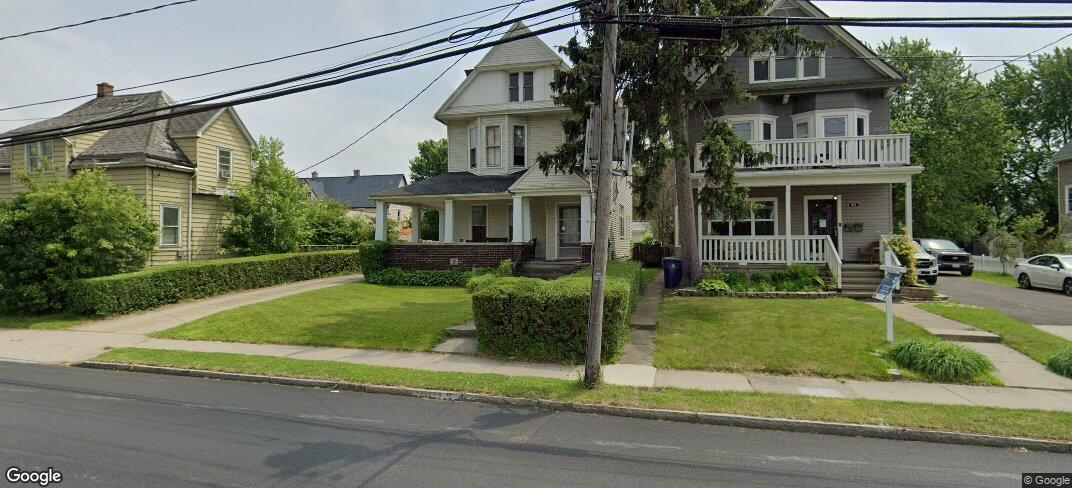
Construction Date: 1893
Original Use: Single-family home
Second Use: Sisters of Mercy-Hospital
Current Use: Single-family home
Built as a single-family house at the turn of the century into the 1940’s for John E. Schintzius a local fruit and produce merchant and his wife, Ruth. He was a merchant at 38 market st. He made significant donations to Holy Family Church and the Sisters of Mercy include the residence. They occupied the home in the 1950’s and 1960’s. The hospital held 30 beds for Irish immigrants injured in the War. The home remained on the market for 13 years before Bob and Suzanne Stanczyk purchased the home in 1978 for their young, growing family. The house was purchased by their eldest daughter Erika and her husband Ted Cizma in 2018.
- Structure: Identified as a two-story multi-family building constructed circa 1893
- Location: Situated in the South Buffalo area, often associated with industrial and residential expansion in the early 20th century, particularly near the former Hanna Furnace site.
- Size: 935 Tifft St is a 2,435 square foot house on a 9,360 square foot lot with 6 bedrooms and 2 bathrooms.
- Sales History:
Key Facts on the Near-Extermination:
- The Scale: Between 1870 and 1884, millions of bison were slaughtered for hides, meat, and sport, leaving fewer than 325 in the wild by 1884.
- Method of Destruction: Commercial hunting was incentivized, and railways often facilitated the destruction, allowing passengers to shoot buffalo from trains.
- Intentional Policy: The U.S. government viewed the buffalo’s destruction as a way to force Native tribes onto reservations, often summarized by the phrase: “Every buffalo dead is an Indian gone”.
- The Turn of the Century: By 1900, only small, protected herds remained, mostly in Yellowstone National Park, marking the start of a slow conservation comeback.
- Usage: Bones were shipped east to be ground into fertilizer, and hides were used for industrial belts and luxury coats.
The property sold for $149,000 in May 2018 from Bob and Suzannes Stanczyk to Erika (Stanczyk) Cizma and Ted Cizma. -Map as of 2026-By the 1920s, conservation efforts were underway to save the species from total extinction, though they remained profoundly scarce compared to their original numbers.